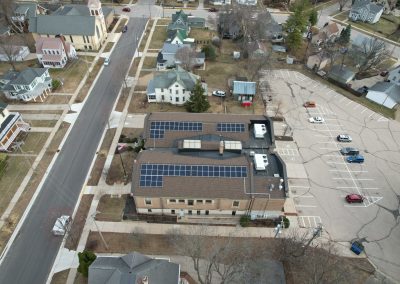
The Solar Builder article, “Rooftop Solar Aids Affordable Housing in Milwaukee | Projects Weekly,” highlights a 191-kW rooftop solar installation completed by Arch Solar and SolarEdge Technologies at a newly developed affordable housing and community library complex in Milwaukee. The project is designed to advance energy equity by bringing renewable energy savings to an underserved neighborhood while supporting the long-term affordability of housing and community services. The solar array is expected to offset approximately 38% of the site’s electricity consumption, generating more than 221 MWh of clean energy annually.
The development serves a low-income community and includes 93 townhouse-style affordable housing units alongside a renovated public library. By reducing utility costs for both residents and community facilities, the project helps lower operating expenses and improve economic stability for households and organizations that rely on these resources. The installation is part of a broader City of Milwaukee initiative focused on increasing access to on-site renewable energy in underserved neighborhoods.
Arch Solar installed the system across three separate rooftops with different configurations, requiring a flexible design approach. The company utilized a combination of SolarEdge SE50K and SE10K inverters along with dual-input power optimizers. This technology enabled longer string lengths, reduced wiring and conduit requirements, and lowered balance-of-system costs, helping the project stay within the budget constraints common to affordable housing developments. Centralized monitoring also allows operators to manage all three buildings through a single platform.
The project is projected to save approximately $35,000 in utility costs during its first year and generate an estimated $1.68 million in lifetime savings. According to project leaders, the installation demonstrates how thoughtful solar design can deliver meaningful economic and environmental benefits while supporting community development, housing affordability, and sustainability goals. The project serves as an example of how clean energy investments can strengthen local communities while reducing energy burdens for residents who need relief the most.